Knowledge & Insights
Orthofix Clinical Insights & Medical News
Discover advanced surgical techniques, bone stimulation research, and orthopedic device innovations.
Surgical Technologies
Innovations in Precision Surgery
Exploring machine-vision navigation and radiation-reduced operating room solutions.
Patient Outcomes
Evidence-Based Patient Care
Real-world recovery stories and clinical data driving modern orthopedic restoration.
Top WaveForm 3D Printed Interbody Implants Suppliers
Table of Contents
- WaveForm 3D Printed Interbody Implants: Definition and Core Design
- How WaveForm 3D Printed Interbody Implants Are Manufactured
- Key Biomaterials and Structural Features of WaveForm Implants
- Clinical Applications and Potential Benefits in Spinal Fusion
- How to Evaluate WaveForm Interbody Implant Suppliers
- FAQS
- Conclusion
- Related Posts
WaveForm 3D Printed Interbody Implants are changing how surgeons and hospitals evaluate spinal fusion technologies. Their porous structures can support bone growth, while patient-specific designs may improve anatomical fit. Yet impressive geometry alone does not prove clinical value. Supplier quality matters just as much as printer capability.
Dr. Kern Singh, a recognized spine surgeon and educator, offers a practical reminder: “Technology matters only when it improves patient care.” That principle shapes this review of top WaveForm 3D Printed Interbody Implants suppliers. The strongest companies combine titanium expertise, validated additive manufacturing, and consistent quality control. They also provide transparent data on porosity, surface roughness, fatigue strength, sterilization, and long-term performance. Details matter.
A reliable supplier should explain how its implants move from digital modeling to final inspection. It should document material traceability and testing procedures. Surgeon feedback also deserves attention, especially regarding insertion, imaging, and fusion evidence. Some suppliers publish excellent technical information but provide limited independent clinical follow-up. That gap deserves scrutiny.
Not every claim is equally strong. Marketing language can outpace published evidence. Buyers should compare regulatory documentation, manufacturing experience, design flexibility, and post-market support. Hospital procurement teams may also examine training resources and inventory stability. These practical factors are easy to overlook.
The market remains promising, but not settled. Better designs may reduce complications, yet outcomes depend on surgical technique, patient biology, and careful selection. This overview highlights suppliers that demonstrate credible engineering, responsible communication, and a meaningful commitment to clinical improvement.
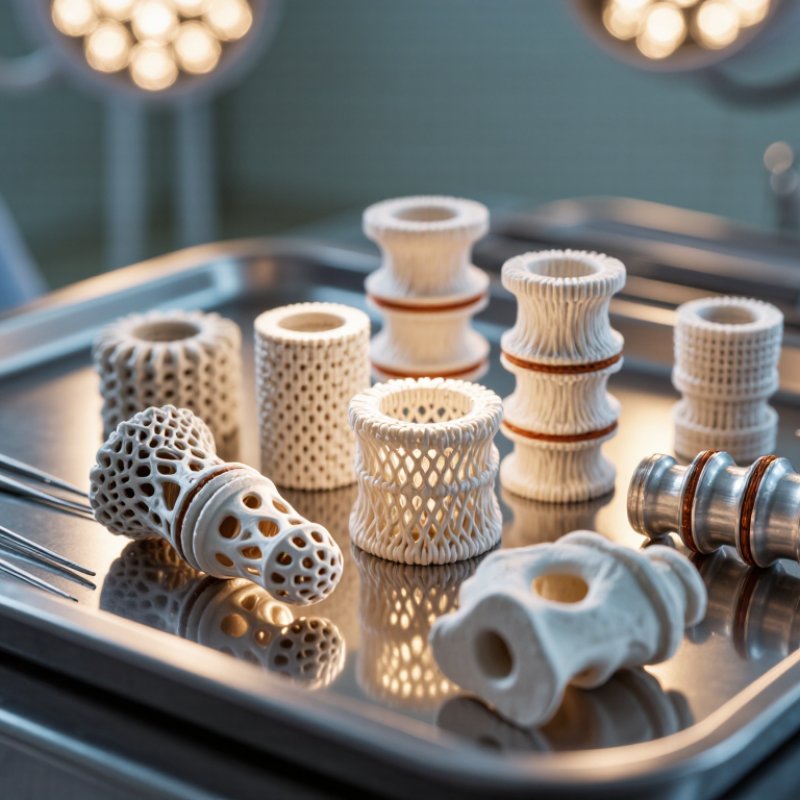
WaveForm 3D Printed Interbody Implants: Definition and Core Design
WaveForm 3D printed interbody implants use curved, repeating surfaces to support spinal fusion. The term “WaveForm” is not always standardized across medical suppliers. It usually describes an implant with undulating outer geometry or a wave-like porous structure. These shapes can improve contact with vertebral endplates and create space for bone graft material. Additive manufacturing also allows controlled pores, internal channels, and patient-specific dimensions. Small details matter.
Core design begins with endplate fit, implant height, and controlled lordotic angle. A well-designed cage should resist migration without excessive endplate stress. Its porous region must balance bone ingrowth with mechanical strength. Too much openness may weaken the structure. Too little openness may limit biological integration. Material selection, surface roughness, imaging behavior, and sterilization validation also require careful review. Independent testing and regulatory documentation should support every technical claim.
Tips: Ask suppliers for fatigue data, pore-size ranges, material certificates, and validated cleaning procedures. Review CT compatibility and radiographic markers with the surgical team. Compare the implant’s footprint with the patient’s endplate anatomy, not only its catalog dimensions. Surgeons should assess fixation strategy and graft access during planning. Marketing language can sound precise, but definitions may differ. That deserves scrutiny.
Top WaveForm 3D Printed Interbody Implants Suppliers - WaveForm 3D Printed Interbody Implants: Definition and Core Design
| Evaluation Dimension | Technical Definition or Typical Data | Core Design Significance | Supplier Capability Indicator |
|---|---|---|---|
| Implant definition | A spinal interbody cage manufactured with layer-by-layer additive manufacturing and a wave-form or lattice-based porous architecture. | Combines structural spinal support with a porous surface intended to encourage bone attachment and fusion. | Documented design history, intended-use definition, and traceable additive-manufacturing process. |
| Primary material | Implant-grade titanium alloys, commonly Ti-6Al-4V, are widely used for load-bearing spinal implants; radiolucent polymers such as PEEK are also used in interbody devices. | Titanium provides high strength and biocompatibility, while PEEK offers an elastic modulus closer to cortical bone and improved imaging visibility. | Material certificates, powder or polymer-grade controls, supplier qualification, and implant-grade traceability. |
| Wave-form architecture | A repeating curved, sinusoidal, or lattice-like geometry engineered within the implant body or porous region. | Supports controlled stiffness, load distribution, and bone-ingrowth pathways while reducing unnecessary solid material. | Validated CAD-to-print workflow, lattice simulation, dimensional inspection, and design-change control. |
| Porosity and pore structure | Porosity, pore size, interconnectivity, and strut geometry are application-specific and must be validated rather than assumed from a nominal design value. | Interconnected pores can facilitate tissue penetration and fluid transport; excessive porosity may reduce mechanical strength. | Micro-CT or equivalent inspection, pore-architecture reports, and mechanical testing on production-representative samples. |
| Endplate contact surfaces | Textured, porous, or toothed surfaces may be used to increase friction and resist migration after implantation. | Surface geometry is designed to improve initial fixation while limiting excessive endplate damage. | Migration, subsidence, surface roughness, and insertion-force data from validated test methods. |
| Mechanical performance | Relevant evaluations include compression, compression-shear, subsidence, fatigue, and static or dynamic failure testing. | The implant must maintain stability under expected spinal loading without premature deformation or fracture. | Testing aligned with applicable spinal implant standards, defined acceptance criteria, and lot-level quality records. |
| Imaging compatibility | Titanium generally creates more imaging artifact than radiolucent PEEK; artifact levels depend on implant geometry and imaging modality. | Imaging visibility affects postoperative assessment of fusion, implant position, and adjacent anatomy. | MRI safety information, artifact characterization, and clearly defined material and imaging conditions. |
| Manufacturing method | Metal powder-bed fusion is commonly used for complex titanium lattices; polymer interbody implants may use machining, molding, or other qualified processes. | Additive manufacturing enables integrated porous structures that are difficult to produce through conventional machining. | Validated build parameters, powder reuse policy, thermal treatment controls, cleaning, and surface-finish verification. |
| Sterilization and cleanliness | The finished device requires validated cleaning, packaging, and sterilization or an approved sterile-supply configuration. | Complex pores and internal channels require effective removal of manufacturing residues and process contaminants. | Residual-powder testing, biocompatibility evidence, validated sterilization, and packaging-integrity controls. |
| Regulatory and quality system | Commercial supply requires a quality-management system, risk management, verification and validation, production controls, and applicable market authorization. | Regulatory documentation links design intent, manufacturing consistency, safety, and clinical performance. | Current quality certification, device history records, supplier audits, complaint handling, and post-market surveillance processes. |
How WaveForm 3D Printed Interbody Implants Are Manufactured
WaveForm 3D printed interbody implants begin with medical-grade titanium powder and a digitally engineered lattice. Engineers design channels for bone growth, load transfer, and controlled porosity. The 2024 Wohlers Report valued the global additive manufacturing industry at approximately $20.0 billion in 2023, showing its expanding industrial maturity. However, growth does not remove clinical responsibility.
A powder-bed fusion system melts each layer with a focused energy beam. Layer thickness, laser power, scanning speed, and chamber oxygen levels require close monitoring. After printing, technicians remove loose powder and inspect the implant using dimensional checks and computed tomography. Heat treatment can reduce internal stress. Surface treatment may improve biological integration, but it also changes roughness and cleaning requirements. Small defects matter.
The U.S. Food and Drug Administration advises manufacturers to validate materials, software, process controls, and finished-device performance for additive medical devices. That guidance makes supplier qualification more than a price comparison. Buyers should request batch records, powder traceability, sterilization evidence, and mechanical testing data. Yet no manufacturing route is perfect. A visually clean implant can still contain hidden porosity or weak interfaces. Experienced suppliers therefore combine in-process monitoring with destructive testing and documented corrective actions. Independent review remains valuable, especially when lattice geometry becomes complex.
Key Biomaterials and Structural Features of WaveForm Implants
Top WaveForm 3D Printed Interbody Implants Suppliers
Key Biomaterials and Structural Features of WaveForm Implants
WaveForm interbody implants commonly use porous titanium alloys or radiolucent PEEK. Titanium provides strong fixation and supports bone-friendly surface roughness. PEEK offers imaging clarity and an elastic modulus closer to cortical bone. Material choice matters.
A 2024 Wohlers Report valued global additive manufacturing at 20.035 billion US dollars in 2023, with 13.5% annual growth. That figure reflects manufacturing activity, not clinical success. Suppliers must therefore provide implant-specific evidence, not general printing claims.
Look for validated powder control, laser parameters, and lot-level traceability. ASTM F2077 evaluates static and dynamic cage performance. ASTM F2267 examines subsidence resistance. These tests help compare structural safety under controlled loading.
WaveForm geometry usually combines a contoured outer wall, internal lattice, and graft windows. The lattice can reduce weight while preserving compressive strength.
Its pore size and connectivity influence bone ingrowth and fluid movement. Yet, “more porous” is not automatically better.
Excessive porosity may reduce fatigue strength or complicate cleaning validation. FDA guidance for spinal systems also emphasizes mechanical testing, biocompatibility, and manufacturing controls.
Supplier audits should review CT inspection, surface treatment, sterilization records, and nonconformance rates. Small details matter.
I would still question any supplier using only benchtop results. Clinical durability depends on anatomy, loading, surgical technique, and follow-up time.
Wang et al. reported in a 2023 systematic review that evidence for 3D-printed spinal cages remains promising but heterogeneous. That uncertainty deserves honest disclosure.
Clinical Applications and Potential Benefits in Spinal Fusion
Three-dimensional printed interbody implants are increasingly used in cervical and lumbar spinal fusion. Their porous surfaces may support bone ingrowth and improve implant integration. Patient-specific geometry can also help restore disc height, spinal alignment, and foraminal space.
Clinical use depends on diagnosis, bone quality, surgical approach, and imaging findings. Surgeons may consider these implants for degenerative disc disease, instability, recurrent disc problems, or selected deformity cases. Potential benefits include strong structural support, controlled lordotic angles, and improved contact with vertebral endplates. Their radiolucent regions can make fusion assessment easier on follow-up scans. Still, a sophisticated design does not guarantee fusion. Subsidence, migration, infection, and nonunion remain possible. Long-term evidence is also developing, and early radiographic improvement may not equal lasting pain relief.
Tips: Match implant geometry to the patient’s anatomy and endplate condition. Confirm sizing with high-quality imaging. Review bone density before surgery. Monitor alignment, subsidence, and fusion progress over time. Discuss realistic outcomes, including the possibility of revision surgery. A careful plan matters more than novelty.
How to Evaluate WaveForm Interbody Implant Suppliers
Evaluating WaveForm interbody implant suppliers requires more than comparing catalog images or quoted prices. Start with the implant’s geometry, material, pore structure, and intended surgical application. Ask whether engineers can explain how the shape supports placement and load distribution. Request design verification data, fatigue testing methods, and imaging compatibility information. Clear answers show practical expertise. Vague promises deserve caution.
Review the supplier’s manufacturing controls in detail. Examine material certificates, lot traceability, dimensional inspection records, and sterilization documentation. A reliable supplier should explain how defects are detected before shipment. Their quality system should align with applicable medical-device requirements in the target market. Ask for relevant clinical evidence, not only laboratory results. Experience matters. Speak with surgeons or hospitals that have used comparable implants, while remembering that one positive opinion cannot replace broader evidence.
Evaluate support after purchase. Can the supplier provide surgical training, planning guidance, and responsive technical assistance? Check inventory stability, delivery history, complaint handling, and procedures for field actions. Ask difficult questions. Notice the response.
A supplier may present impressive prototypes yet struggle with consistent production. That gap is easy to miss during an early meeting. I would also compare revision feedback and long-term follow-up data, even when the information feels incomplete. No supplier is flawless. The stronger choice is usually the one that acknowledges limitations, shares verifiable records, and improves its process when evidence exposes a weakness.
This chart presents an illustrative evaluation-weight framework for WaveForm 3D printed interbody implant suppliers. Clinical evidence, regulatory controls, design validation, additive manufacturing process control, material verification, sterilization, and supply support are key dimensions to review. The percentages represent suggested evaluation priorities, not the performance of any specific company or brand.
FAQS
Common materials include porous titanium alloys and radiolucent PEEK. Titanium supports fixation and bone-friendly surface texture. PEEK improves imaging clarity. Material choice matters.
Medical-grade powder is fused layer by layer using a focused energy beam. Engineers control layer thickness, laser power, scanning speed, and chamber oxygen. Loose powder is removed afterward. Small defects matter.
The lattice supports load transfer, bone growth, and controlled porosity. Pore size affects bone ingrowth and fluid movement. More porosity is not always better. It may reduce fatigue strength.
Technicians perform dimensional checks and computed tomography inspections. They may also use heat treatment to reduce internal stress. Surface treatment can improve integration. It also changes cleaning requirements.
Request material certificates, powder traceability, batch records, and sterilization evidence. Ask for mechanical testing and dimensional inspection data. Nonconformance records are useful. Missing records deserve caution.
Static and dynamic cage testing evaluates performance under controlled loading. Subsidence testing examines resistance to sinking into bone. These tests support comparison. They do not predict every clinical outcome.
Review manufacturing controls, software validation, defect detection, and lot-level traceability. Ask how the supplier handles failed inspections. Speak with surgeons or hospitals when possible. One positive opinion is not enough.
Laboratory results cannot fully predict long-term clinical durability. Anatomy, loading, surgical technique, and follow-up time all matter. Evidence remains uneven. I would question any supplier offering only polished prototypes.
Conclusion
WaveForm 3D Printed Interbody Implants are spinal fusion devices designed with engineered wave-like geometries, porous structures, and patient-focused shapes to support stability and bone integration between vertebral segments. They are commonly produced through additive manufacturing, which builds each implant layer by layer from medical-grade materials such as titanium alloys or advanced polymers. This process enables precise control over height, surface texture, internal porosity, and implant configuration while supporting consistent quality management.
Key structural features may include interconnected pores, radiographic markers, optimized load-bearing zones, and surfaces intended to encourage bone growth. These implants can be considered for selected spinal fusion procedures, including cervical, lumbar, and other interbody applications, where restoring alignment and maintaining disc-space height are important clinical goals. When evaluating WaveForm 3D Printed Interbody Implants suppliers, buyers should examine material certifications, manufacturing accuracy, sterilization procedures, quality systems, design flexibility, testing data, regulatory compliance, technical support, and long-term supply reliability. A thorough assessment helps healthcare organizations select suitable solutions based on clinical requirements and documented product performance.

Blog Tags: